




Eating Barracuda: The One Rule That Matters
Look, I’m not here to scare you off a perfectly good fish. Barracuda can be excellent eating firm, meaty, fantastic on the grill. But it’s also the one fish where I’ll look you dead in the eyes and say: where it was caught matters more than literally anything else you do in the kitchen.
The same species can be totally safe from one coast and send you to the hospital toxic from another. And here’s the kicker you can’t tell the difference by looking at it, smelling it, or tasting it. The fish doesn’t look sketchy. It doesn’t smell off. It just… quietly ruins your week.
So before you fire up the grill, let’s talk about what’s actually going on here and how to eat barracuda without playing digestive roulette.
Why Location Is the Whole Ballgame
This isn’t about the fish going bad. It’s about what the fish ate which depends entirely on where it lived.
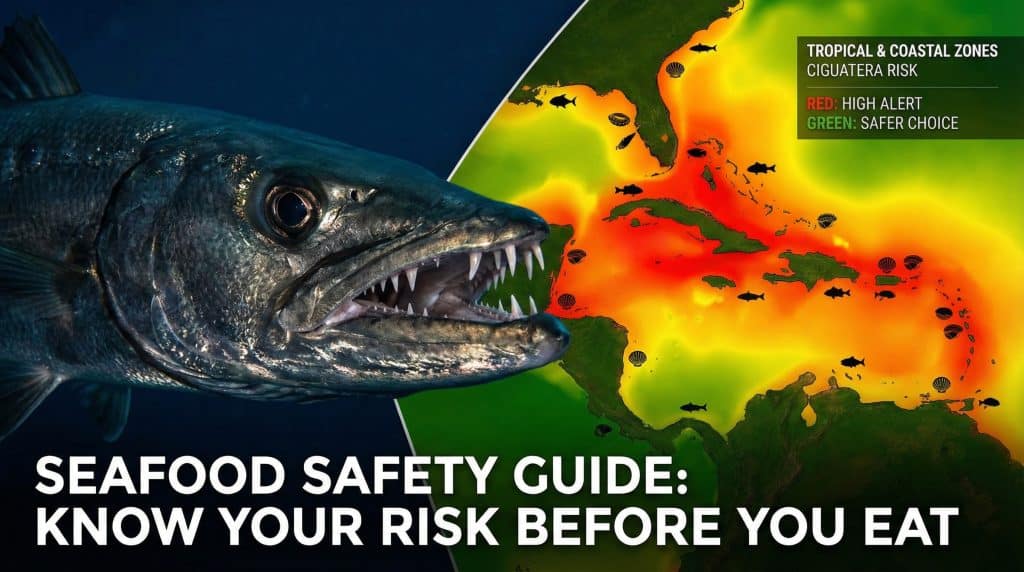
In certain tropical waters, a toxin called ciguatoxin builds up through the food chain. Tiny algae grow on dead coral. Small fish eat the algae. Bigger fish eat those fish. And barracuda apex predators that they are eat everyone, accumulating the highest toxin levels of all.
Here’s the part that gets people: there’s no at home test for this. No smell, no visual cue, no “if it’s slimy, toss it” rule. Your only real protection is knowing which waters are high risk and which aren’t.
That’s it. That’s the whole game.
Two Fish, Two Very Different Stories
When you see “barracuda” on a menu, it could mean different fish depending on where you are and this distinction is the difference between a good dinner and a really bad time.
Great Barracuda is the one you’ve heard warnings about. Found across the tropical Atlantic, Caribbean, and Indo-Pacific, this is the species tied to ciguatera poisoning. It’s also delicious, which is annoying.
Pacific Barracuda lives off Southern California in cooler water where the toxin producing algae can’t survive. If you’re eating barracuda in San Diego or LA, it’s probably this guy, and your ciguatera risk is basically nil. (Mercury’s still a thing with any big predator fish, so pregnant folks and little kids should still go easy but that’s true of most seafood.)
The problem? Both species often get labeled just “barracuda.” Same name, wildly different risk. Always ask which one you’re getting.
Size, Season, and the Myths That Won’t Save You
Size Matters (But Not As Much As You’d Hope)
A smaller barracuda has had less time to stockpile toxin. Around 36 inches is where risk tends to climb some Florida counties won’t even let you keep fish bigger than that.
But here’s my caveat: a small fish from a sketchy reef can carry more toxin than a bigger fish from clean water. Size is a clue, not a guarantee.
Season Plays a Role Too
May through August is peak risk because warmer water helps those toxin producing organisms thrive. Winter catches from the same areas typically carry less toxin.
The Kitchen Tricks That Will NOT Protect You
I need you to hear this part clearly, because people get this wrong all the time:
- Cooking doesn’t help. Frying, grilling, boiling ciguatoxin survives all of it.
- Freezing doesn’t help. The toxin just sits there, unbothered.
- Lime juice doesn’t help. Ceviche won’t save you.
- The fish looks and smells completely normal. I know. It’s maddening.
- “Folk tests” are nonsense. Feeding scraps to your cat or checking if ants avoid it? Please don’t.
Only lab testing can confirm contamination. Your practical protection is verifying where the fish came from and CDC ciguatera warning details back that up.
The Three Zone Map: Your Cheat Sheet
I think of barracuda waters in three tiers. Start here, then layer on the species/size/season stuff as backup filters.
Zone 1: Just Don’t
Bahamas, Florida Keys, Caribbean, Hawaii, Pacific Islands, Indo-Pacific reefs.
This is the danger zone. Testing shows roughly 60% of great barracuda in the Bahamas have detectable ciguatoxin. The Keys consistently report high rates. The broader Caribbean, Hawaii, Fiji, Guam, Philippines same story.
I don’t care how good it looks on the menu. I don’t care if the server says they eat it all the time. In these waters, barracuda is a no for me.
Zone 2: Proceed With Extreme Caution
South Florida mainland (Miami-Dade, Palm Beach), Gulf of Mexico offshore.
Risk is real but less consistent. NOAA sampling in the Gulf found nearly half of tested barracuda had measurable toxin, with almost 1 in 5 at illness causing levels.
If you’re going to eat barracuda from these areas, you need to know the exact catch location, the species, and ideally the size. If a seller can’t tell you those things? Walk away.
Zone 3: Your Safer Bets
Northern Florida (north of Palm Beach), California’s Pacific coast, U.S. Atlantic from the Carolinas north, Pacific Northwest.
These waters are either too cold for the toxin producing algae or you’re getting Pacific Barracuda (the lower risk species). Northern Florida sees scattered cases, usually tied to fish that picked up toxin farther south.
One heads up: climate change is expanding ciguatera’s range. The Canary Islands and Madeira are now reporting cases that weren’t historically common. Safe zones today might not be safe zones forever.
What Ciguatera Actually Feels Like
(This is general awareness stuff if you think you’ve got it, get to a doctor.)
Symptoms usually hit 1-12 hours after eating, most often within 2-6 hours. It starts like regular food poisoning: nausea, vomiting, stomach cramps. Easy to dismiss.
Then it gets weird.
The signature symptom is temperature reversal cold things feel burning hot, hot things feel cold. Ice water feels like it’s scalding your mouth. If that happens, you’re not dealing with bad shrimp. You’ve got ciguatera.
Other fun times include tingling in your fingers and lips, joint pain, weakness, and intense itching that and I love this detail gets worse if you drink alcohol. Symptoms can last days, weeks, or sometimes months.
If you experience trouble breathing, chest pain, severe weakness, or that temperature reversal, get medical help. Tell them what fish you ate, where it was from, and when symptoms started.
How to Buy Barracuda Without Regret
Before you hand over your money, get answers to these questions:
- Where exactly was it caught? (“Florida” is too vague. “Marathon, Florida Keys” is an answer.)
- What species is it? Great barracuda or Pacific barracuda?
- How big was the fish?
- When was it caught?
Red flags: vague answers like “local” or “Atlantic,” inability to provide details, steep discounts on a known risk fish, or dismissive “we serve it all the time” vibes.
If you’re cleaning your own catch from a lower risk area: the liver, intestines, roe, and head can hold 10-20x more toxin than the fillet. Don’t eat them. Also remove that dark bloodline down the center toxin tends to collect there.
Or Just… Eat Something Else
If this all sounds like too much homework, I get it. Here are some lower drama alternatives:
Mahi-mahi is my go to swap similar firm texture, much lower ciguatera risk because it feeds offshore rather than around reefs. Yellowfin or skipjack tuna work too. For something completely different, cod and haddock from cooler waters sidestep the whole tropical reef situation.
No shame in picking the easier path.
The Bottom Line
Barracuda is genuinely great eating from the right place. The catch location is doing all the heavy lifting here. Stick to the safer zones, always demand specifics on species and origin, and if a seller can’t answer your questions or gets cagey about it, just order the mahi.
A few seconds of asking beats a few weeks of temperature reversal and regret. Trust me on this one.